Cart - 0 Item
You have no items in your shopping cart.

How to use braided line wisely: sensitivity, strength and abrasion resistance
Recent innovation of Poly-Ethylene braid line (PE line, Spectra(R), Dyneema(R) line) has brought us amazing strength and sensitivity. However, the line is not perfect itself. It breaks easily because it doesn't absorb shocks, has less resistance to abrasion than mono-line, and is weak to heat. Therefore to exploit the advantage of the braided lines, we need to lean how to use them. And, one answer is to add a mono-filament leader to the braided main line to make a line system. Then you may add the lacking aspect, abrasion resistance and impact resistance to your lines. (Please see how to choose PE Braid line for more details)
Great sensitivity brings you clues and fish. If you could feel a fish chasing your lure but she didn't bite on it, you may catch her by changing something. You may feel some difference in line load and may find currents in water, where fish stay. The braided lines give you the kind of clues, and I strongly recommend you to use braided lines, especially for deep water fishing. With the super sensitivity fishing is more interesting, and your learning curve will turn steep arise.
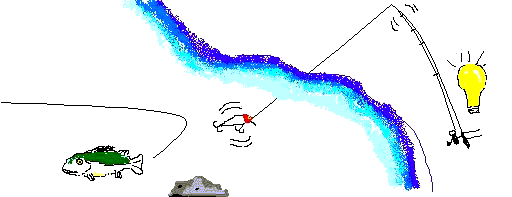
Low stretch is the key of braided lines. PE braid line has only 4% stretch, and nylon has 20-40%. The difference immediately affect the sensitivity. However, less stretch also means less shock resistance. Braided lines breaks easily when it receives impact, like hooking a jig on big bass with heavy action rod. Therefore, by adding mono-filament leader, line system has adequate impact absorber to prevent shock break.
Low abrasion resistance is another reason to add mono-leader. Braided lines have very low abrasion resistance, and it easily break when it touches to boat bottom at load. Nylon and Fluorocarbon lines have been sophisticated and now have great resistance to abrasion. And we take advantage of the advanced lines.
Ultimate line system with PE braid (spectra) line has
1) Super sensitivity of PE braided line
2) Resistance to abrasion and impact (shock)
3) Great strength as total.
Here are some examples of the line system.
| Line system | Casting by spinning for mahe | Jigging for king fish |
| Main line | PE braided 30 lb | PE30-40 lb |
| Leader | Nylon 30lb 3-5ft | Fluorocarbon 30-40lb 10-20ft |
PE braid lines need innovative knot because they are very slippery, and weak when compressed. I strongly recommend friction knot system like SF, FG and SIG knot. With traditional knot, like clinch knot or uni-knot they easily break(slip) before expected strength, at about 50-65%. Traditional knots are almost useless.
With friction knot system, lines will not be tied, but has a lot of friction surface to be fasten. These systems have been used mainly for offshore big games. SIG knot is recently invented by Mr.SIG, an avid offshore and bay area sea bass fisherman. These knots are a little complicated, and will take some time to learn. Another advantage of these knots are they are very small, and has less friction with recent Fuji concept guides.
How to make friction knot?: Bimini twist at the end of PE main line to make a loop. Then tie the leader and the loop with SIG knot.
Here is the details of popular line materials.
| Nylon line | Fluorocarbon line | Poly Ethylene line (PE) (Spectra, Dyneema) | |
| Available brands | Stren, Trilene, Ande | Seaguar, P-Line, X-Tex, | Spider Wire, Power Pro, Fireline |
| Weight ratio: Water = 1.0 | 1.15 Sink slowly | 1.78 Sink very fast | 0.97 Float |
| Refractive index(*1: Water = 1.33 | 1.52-1.63 | 1.42 | 1.54(*2 |
| Resistance to abrasion | Good | Fair | Poor |
| Strength set Nylon as 1 | 1 | 1 | 3-4 |
| Strength at knot | Good | Very good | Fair |
| Stiffness | Soft | Hard(*3 | Very soft(*4 |
| Stretch before break | 20-45% | 17-37%(*5 | 4% |
| Absorb water (weight) | 8-10% | 0.01% | 0 |
| Damage from Ultraviolet rays | High | Close to 0 | Close to 0 |
(*1 If the index is close to 1.33, it is hard to be seen in water
(*2 PE line are composed of fine filaments, and it is opaque as a line
(*3 Well designed lines have hybrid construction to have softer body
(*4 Most lines are coated to have harder body
(*5 Fluorocarbon has less stretch at low tension
To read more topics Tackle Topic Top
