Cart - 0 Item
You have no items in your shopping cart.

Japanese Silk
Fishing Lines
During 30's- 50's, silk was one of the most important industry in Japan, and Japan was the largest exporter of quality silk. Now the industry has moved to more cost-efficient regions like China and Brazil, and silk industry is gone. However, the technologies and quality by the time still can be seen in the today's fishing lines. Adding to the heritages from silk industry, engineer's significant effort to satisfy highly demanding anglers helped the fishing line industry to have globally selling great products today.
Nylon was invented by Dupont as Nylon 66 mono-polymer in 30's, and it is still the main material for fishing line. It is inexpensive, strong, transparent, and relatively abrasion resistant. Premium Nylon lines today are added with abrasion resistant coatings, hardener for more sensitivity, softener for easier casting, and slippery coatings for further casting ranges, for respective target usages. As general, they have quite even surface, and really round section today. Fluorocarbon line was introduced by Kureha (Seaguar) in 1971. It has much harder body and less stretch rate at low load than Nylon., and it is more sensitive. It has long been used as leader because it was very stiff and wouldn't fit to spools. Recent re-invention of Fluorocarbon line is due to the innovation to produce a line with multiple material, like soft core and hard surface. Toray's Super Hard Pro Fluorocarbon line, introduced in 1992, has changed the standard line for finesse rigs. Now, most freshwater angler in Japan spool fluorocarbon lines to spinning reels. Fluorocarbon line sinks fast in water, and it also help light rigs to reach fishing range with smaller sinkers. Regarding polyethylene braid line, I have another topics and please read it at Tackle Topics.

Left: silk manufacturing in 40's (Miyamoto Silk)
Card reading first silk factory in Japan
LB-test standards in Japan and US are different. Japanese and US shared LB-test standard in the past, when original Stren (Dupont) was introduced as premium game fishing line, around 70's. Before the Stren, Japanese line was gauged by weight, not by strength. As Japanese anglers educate themselves with LB-test, most line manufacturers started to indicate LB-testing of lines. However, after they started improving their products, line standards in both countries started to divert in two ways. US line manufacturers kept the thickness and indicated LB-test remained, but sold newer lines as "stronger" lines. Instead Japanese line manufacturers kept the real strength and indicated LB-test remained but sold thinner lines as "casting farther and catching more." Therefore, US lines tend to be thicker and stronger than Japanese lines with the same lb-test.
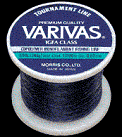
Adding to the difference in marketing strategies, IGFA (International Game Fishing Association) rule has large effect on Japanese lines. Under the IGFA rule, lines have to break before the indicated LB-test. Japanese line manufacturers see IGFA line qualification as a quality standard, and they manufacture line strength as close to its indicated LB-test as possible, but not exceed it. IGFA will disqualify the record, if the line used overtests.
Right:Varivas IGFA line
Please take a look at following chart. Mostly, Japanese lines are 1-2 level thinner than US lines if we compare the same LB-test line. It doesn't mean Japanese lines are stronger. I believe the strengths of materials are mostly identical for basic lines. The US lines are just stronger than indicated LB-test. It is good for bass fishermen, but not good for record seeking anglers. Please make sure you use IGFA qualified line when you challenge for a record in a LB-test class. I also added the traditional Japanese weight gauged numbers "gou" as # numbers. These indications are still popular among anglers. 4lb line in Japan is called as #1 gou line, and 8lb is #2 gou. Strength and weight are directly proportional, and "gou" is easy to to understand and remember.
Nylon line LB-test and thickness standards (data from Toray and Stren) Lines of most comparable thickness are listed side by side.
| Japan | ||
|---|---|---|
| LB-test | Dia (mm) | JP line# gou |
| 1 | 0.090 | #0.3 |
| 1.5 | 0.104 | #0.4 |
| 2 | 0.128 | #0.6 |
| 3 | 0.148 | #0.8 |
| 4 | 0.165 | #1 |
| 5 | 0.185 | |
| 6 | 0.205 | #1.5 |
| 8 | 0.235 | #2 |
| 10 | 0.260 | #2.5 |
| 12 | 0.285 | #3 |
| 14 | 0.310 | #3.5 |
| 16 | 0.330 | #4 |
| 20 | 0.370 | #5 |
| 22 | 0.405 | #6 |
| 25 | 0.435 | #7 |
| 30 | 0.470 | #8 |
| 35 | 0.520 | #10 |
| 40 | 0.570 | #12 |
| 50 | 0.620 | #14 |
| 55 | 0.660 | #16 |
| 60 | 0.700 | #18 |
| 70 | 0.740 | #20 |
| 80 | 0.780 | #22 |
| 90 | 0.810 | #24 |
| 95 | 0.840 | #26 |
| 100 | 0.870 | #28 |
| US | ||
|---|---|---|
| Dia (mm) | LB-test | Dia (inch) |
| 0.152 | 2 | 0.006 |
| 0.203 | 4 | 0.008 |
| 0.254 | 6 | 0.010 |
| 0.279 | 8 | 0.011 |
| 0.305 | 10 | 0.012 |
| 0.330 | 12 | 0.013 |
| 0.356 | 14 | 0.014 |
| 0.406 | 17 | 0.016 |
| 0.457 | 20 | 0.018 |
| 0.508 | 25 | 0.020 |
| 0.559 | 30 | 0.022 |
| 0.584 | 40 | 0.023 |
| 0.762 | 50 | 0.030 |
These difference cause some troubles when you directly import Japanese model reels because Shimano Japan and Daiwa Japan use Japanese line standard for line capacities. Therefore, if you fill US lines, it typically reduces line capacity at 10-20%, unless you fill thin lines like Stren Magnathin.
Currently the thinnest fishing line available is #0.03, 1lb-test tungsten metal line. It is in 0.029mm dia, or 0.0011 inch. It is about a third of hair thickness. These ultra thin lines are used only for live Ayu luring fishing, where you let Ayu swim river bottom to attract another Ayu attack, and have it hooked by hooks attached to the lure Ayu.
Lines today are far advanced from what we used to see. They are stronger, and mostly more specifically designed for targeted usage. To take the advantage of these advanced lines, we also need to update our knot skills that lines are more slippery than before.
Tight lines,
Read more interesting Tackle Topics
Go back to JapanTackle Home and see more interesting products
